The Comparison of Adjectives
Monosyllabic adjectives are compared with -er, -est.
| positive | comparative | superlative |
| strong | stronger | strongest |
| small | smaller | smallest |
| late | later | latest |
| nice | nicer | nicest |
| big | bigger | biggest |
| thin | thinner | thinnest |
| fat | fatter | fattest |
| London is bigger than Vienna. | ||
Comparison of disyllabic adjectives
Disyllabic adjectives ending with y, er, ow, le are compared with -er, -est.
| positive | comparative | superlative |
| easy | easier | easiest |
| happy | happier | happiest |
| clever | cleverer | cleverest |
| narrow | narrower | narrowest |
| Which is the easiest exercise? | ||
Comparison of all the other adjectives
All the other adjectives are compared with more, most.
| positive | comparative | superlative |
| careful | more careful | most careful |
| expensive | more expensive | most expensive |
| difficult | more difficult | most difficult |
| tired | more tired | most tired |
| terrible | more terrible | most terrible |
| Which dress is more expensive? Which dress is the most expensive? | ||
Comparison of special adjectives
Special adjectives can be compared with -er, -est or more, most.
| positive | comparative | superlative |
| clever | cleverer / more clever | cleverest / most clever |
| common | commoner / more common | commonest / most common |
| likely | likelier / more likely | likeliest / most likely |
| pleasant | pleasanter / more pleasant | pleasantest / most pleasant |
| polite | politer / more polite | politest / most polite |
| quiet | quieter / more quiet | quietest / most quiet |
| stupid | stupider / more stupid | stupidest / most stupid |
| sure | surer / more sure | surest / most sure |
| subtle | subter / more subtle | subtlest / most subtle |
| simple | simpler / more simple | simplest / most simple |
NB! Irregular Comparison Forms NB!
| positive | comparative | superlative |
| good | better | best |
| bad | worse | worst |
| much | more | most |
| many | more | most |
| little | less | least |
(not) as … as
Ann is as tall as Mary.
I think tomorrow it will be as hot as today.
This test was not as difficult as the last one.
Past Simple
Use of the Past Simple.
The Past Simple is used to write and talk about completed actions that happened in a time before the present. It is the basic form of the past tense in English. Study the following information how to form the simple past and how to form the negation and questions.
Regular Verbs
How to form: Infinitive + ed = 2nd form
Examples:
walk + ed = walked
laugh + ed = laughed
want + ed = wanted
Note:
cry – cried – y » i
carry – carried – y » i
love – loved – no e
hope – hoped – no e
stop – stopped – if you speak a short vowel » doubling
drop -dropped – if you speak a short vowel » doubling
Key words: yesterday, last week (month, Monday, October,etc.), in 1984, ago.
Irregular Verbs
| 1st form | 2nd form |
| am, is | was |
| are | were |
| get | got |
| go | went |
| see | saw |
| do | did |
| take | took |
| have | had |
**Ссылка на переход на таблицу неправильных глаголов.
Negation of the Past Simple
How to form: didn’t (= did not) + 1st form
He didn’t go to her last party. They didn’t like his story.
BUT: was not (wasn’t), were not (weren’t), could not (couldn’t)
Questions in the Past Simple
How to form: did + 1st form
Did he go to her last party? Did they like his story?
Where did they live? How did she feel?
Question word – did – person – verb
Was he angry? Were they late? Could they swim?
Personal Pronouns
| Person | Subject Pronouns | Object Pronouns |
| singular | ||
| 1st | I | me |
| 2nd | you | you |
| 3rd (male) | he | him |
| 3rd (female) | she | her |
| 3rd (thing) | it | it |
| plural | ||
| 1st plural | we | us |
| 2nd plural | you | you |
| 3rd plural | they | them |
Prepositions of Place
AT – IN – ON
General Information
AT
We use at for a point: at the window – at the entrance – at the door – at the end of the street – at the station – at the top
Bill is waiting for you at the bus stop.
ON
We use on for a surface: on the wall – on the ceiling – on the floor – on a page – on a cover
Have you seen the notice on the notice board?
IN
We use in for an enclosed space: in the garden – in the house – in London – in the water – in her bag – in a row – in a town
There is nobody in the room. She lives in a small village.
Special Information
AT
- We say that someone is at an event: at a party – at a pop concert – at a conference – at a meeting.
Tom is at a party.
- We say at with buildingswhen we say where the event(film, concert, etc.) takes place.
Where were you yesterday? At the cinema. The meeting took place at the headquarters.
- We say at someone’s house.
We were at Bill’s house last Thursday.
- We say at for a place which is a part of our journey.
We stopped at a very nice village. Does the train stop at Nashville?
ON
- We use on with small islands.
She spent her holiday on a small island.
- We say that a place is on the coast / on a river / on a road.
London is on the river Thames. Portsmouth is on the south coast of England.
IN
- We say in when we talk about a buildingitself.
The rooms in Tom’s house are small.
- We usually say in with townsand villages.
His parents live in York.
Note these expressions
AT
at home – at work – at school – at university – at college – at the station – at an airport – at the seaside – at sea (on a voyage) – at reception – at the corner of a street – at the back / front of a building / cinema / group of people, etc. – arrive at with other places or events
IN
in the newspaper – in bed – in hospital – in prison – in the street – in the sky – in an armchair (sit) – in a photograph – in a picture – in a mirror – in the corner of a room – in the back / front of a car – arrive in a country or town
ON
on a farm – on the left – on the right – on the ground floor – on the first, second,… floor – on the way – on the chair (sit) – on the radio – on television – on a horse – on the corner of a street – on the back / front of a letter / piece of paper etc.
TO – INTO – BY
TO
We say go / come / travel / fly / walk / return / drive / have been etc. to a place or event.
Last year we flew to London. We went to work at seven.
INTO
We say go into / come into etc. = enter a room / building etc..
He opened the door and went into the room.
BY
We say by to say how we travel.
We went to Paris by plane. I usually go to work by bike / by car / by underground / by bus.
BUT:
We say on foot.
We cannot use by if you say my car / the train / a taxi.
We use in for taxis and cars. I was in a taxi when she called me.
We use on for bike / public transport. I rode to school on my bike.
Prepositions of Time
AT
We use at with times: at 5 o’clock – at 11.45 – at midnight – at lunchtime
Tom usually gets up at 7 o’clock.
We use at in these expressions: at night – at Christmas – at the moment / at present – at the same time – at weekends – at the age of…
ON
We use on with dates and days: on 12 March – on Friday(s) – on Friday morning(s) – on Sunday afternoon(s) – on Saturday night(s) – on Christmas Day (but at Christmas)
IN
We use in for longer periods of time: in April – in 1986 – in winter – in the 19th century – in the 1970s – in the morning(s) / in the afternoon(s) / in the evening(s)
In + period of time = a time in the future:
Jack will be back in a week. The train will leave in a few minutes.
In + how long it takes to do something
I learned to drive in four weeks.
DURING
We use during + noun to say when something happens: during the film – during our holiday – during the night
We met a lot of interesting people during our holiday. I fell asleep during the film.
FOR
We use for + a period of time expressing duration: for six years – for two hours – for a week
I’ve lived in this house for six years. They have been watching TV for two hours.
SINCE
We use since + a starting point, a specific time: since April – since 1992 – since 8 o’ clock
It has been raining since one o’ clock. They’ve known each other since they were at school.
UNTIL
We use until/till to say how long a situation continues:
Let’s wait until it stops raining. I stayed in bed until half past nine.
FROM – TO
We use from – to + beginning and end of a period
Last evening, we watched TV from 5 to 8 o’ clock.
Present Progressive
Use of the Present Progressive. The Present Progressive is also called present continuous. It is used to indicate actions happening at the time of speaking or used for planned future actions.
Key words: look, listen, now, at the moment, still, at present
How to form the Present Progressive
I am + verb + ing – I am playing.
he, she, it is + verb + ing – The bird is singing.
you, we, they are + verb + ing – We are dancing.
Look, Ann is running down the street.
She is sleeping now.
Listen, I‘m talking to you!
Negation
I am not (I’m not) + ing form
he, she, it is not (isn’t) + ing form
you, we, they are not (aren’t) + ing form
Question
Are they learning for the test?
Form of to be – subject – ing form
NB! Spelling Note:
take – taking – no e
make – making – no e
run – running – When a short vowel is spoken → doubling of the consonant
sit – sitting – When a short vowel is spoken → doubling of the consonant
lie – lying – ie → y
What’s The Time?
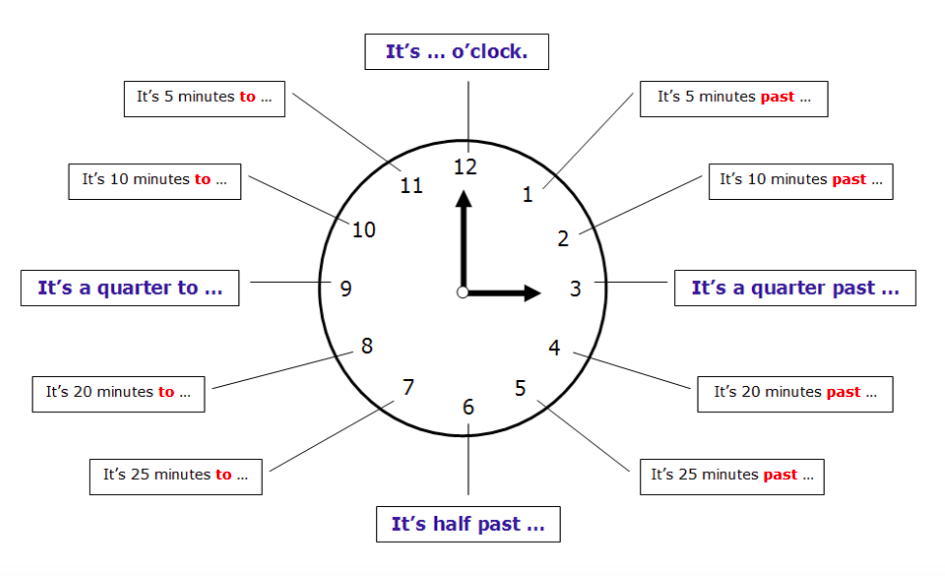
How to tell the time in English
a.m. – p.m.
a.m. = ante meridiem = the time from midnight to noon = from 00:00 to 12:00
p.m. = post meridiem = the time from noon to midnight = from 12:00 to 24:00
The 24-hour clock is the most commonly used time notation in the world today.
But in English speaking countries the 12-hour clock is the dominant system of time written and spoken.
The 24-hour clock is only used by the military in the United States and Canada.
24-hour and 12-hour clock
| Examples: | ||
| 24-hour | 12-hour | |
| 11:00 | 11 a.m. | It’s eleven o’clock a.m. |
| 23:00 | 11 p.m. | It’s eleven o’clock p.m. |
| 10:30 | 10.30 a.m. | It’s half past ten a.m. |
| 22:30 | 10:30 p.m. | It’s half past ten p.m. |
| 04:45 | 4:45 a.m. | It’s a quarter to five a.m. |
| 16:45 | 4:45 p.m. | It’s a quarter to five p.m. |
| 08:15 | 8:15 a.m. | It’s a quarter past eight a.m. |
| 20:15 | 8:15 p.m. | It’s a quarter past eight p.m. |
| 09:10 | 9:10 a.m. | It’s ten (minutes) past nine a.m. |
| 11:20 | 11:20 a.m. | It’ twenty (minutes) past eleven a.m. |
| 21:50 | 9:50 p.m. | It’s ten (minutes) to ten p.m. |
| 19:40 | 7:40 p.m. | It’s twenty (minutes) to eight p.m. |
Simple Future Tense
How to form the Simple Future
will + infinitive (=1st form) – They will be late. / He will come.
Short form: will = ‘ll – They’ll be late. / He’ll come.
Negation: will not = won’t – They will not be late / He won’t come.
Question: Will …. ? – Will they be late? / Will he come?
Key words: tomorrow, next week (month, year, summer, Monday, weekend,…), in 2020…
I think I will meet her tomorrow.
I hope he will be back before 9.30.
I suppose I‘ll be there at five.
Use of the Simple Future
- to talk about future actions we can’t influence or control.
- to foretell future actions or to express hopes, expectations, fears, offers, promises, refusals,… .
Key words: I’m sure, I believe, I expect, I hope, I suppose, I think, I’m afraid, I wonder, I fear, I worry, I promise, I guess or perhaps, possibly, surely, probably, maybe
- with I / we for spontaneous reactions or making promises. I shall is sometimes used instead of I will.